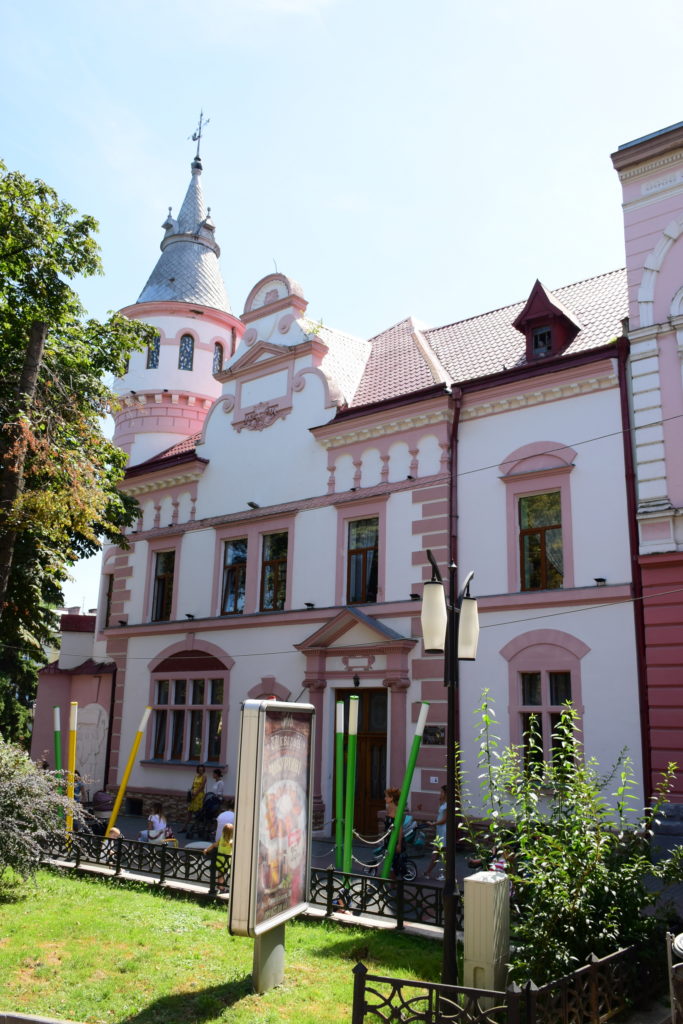
Falcon’s (Sokół) House (2 Mickiewicz Square)
The eclectic Falcon’s House of the late 19th century at the corner of Martyntsia Street (former Kostiushko Street) and Vitovskyi Street (formerly Goslavskyi Street) belongs to the most interesting buildings in Stanislaviv. The building has a richly decorated facade and a typical corner-mounted, cylindrical tower with a spire roof. Neo-gothic elements (arcature, tower with a starling) neo-renaissance (high roof) and neo-baroque elements were used in the building’s decoration.
The building was built in 1895 for the needs of the Polish gymnastic society Sokil (eng. Falcon) (there was also the Ukrainian society Sokil in the city, which was located in the building of Prosvita). This organisation was founded in the middle of the 19th century in the Czech Republic and soon gained popularity among the Slavic nations of the Habsburg Empire. In Stanislaviv, the society was formed in 1884. The key task was the physical and moral upbringing of youth. The accent was put on fencing, heavy athletics and gymnastics. There was even a special „Sokolska gymnastics” (eng. Falcon’s gymnastics).
The local society Sokil was very poor and for a long time could not afford to have its own premises. What to say on the premises, if the funds were lacking even on the project itself. At that time, the committee turned to the well-known Lviv architects for help. The outcome has surpassed all expectations. Stanislaviv received 14 versions of the Falcon’s House. The design of engineer Jan Kudelski has definitively won.
Construction started at full speed and on September 22, 1895, Stanislaviv achieved another magnificent building. The tower resembled some medieval castle. At the top of the tower was a weather vane that we can see nowadays. Unfortunately, the concrete sculpture of the eagle on the pediment has not been preserved. Since the bird was a symbol of the Polish state, the Soviets and the Germans did not tolerate it very much.
In 1905, the artist from Stanislaviv embellished the building with frescoes. The facade was decorated with a copy of Artur Grottger’s ‘Battle’, depicting a scene from the Uprising of 1863: in it a group of rebels struggles in a last ditch effort with the Muscovites. The name of the institution Sokil was to be seen in a rectangular frame placed above the painting, and below, there were 27 coats of arms of Polish lands pictured on the cornice.
A lot of pictures of the pre-war Falcon have preserved, but all of them show the building from the outside. And what was inside? What should be in the gymnastic community is a gymnasium. On a rare photograph of 1925, you can see a spacious room with hanging gymnastic rings, horses and goats, gymnastic sticks and a portrait of Tadeusz Kosciuszko on horseback.
What has happened in these walls during the German occupation remains unknown. In any case, the building happily survived the war. Since August 29, 1945, a new owner – Regional Children’s Library – appeared in the house.
After 2000, during the renovation, the image of the bird on the facade was cleaned out and decided to leave, considering it to be a jackdaw – the symbol of Galicia. In fact, it is one of 27 coats of arms – the coat of arms of the Płock land. The rest of the 26 coats of arms remain under plaster. Maybe someday they will get better times.
Today, the Ivano-Frankivsk Regional Children’s Library named after Petro Kozlaniuk operates in this building.