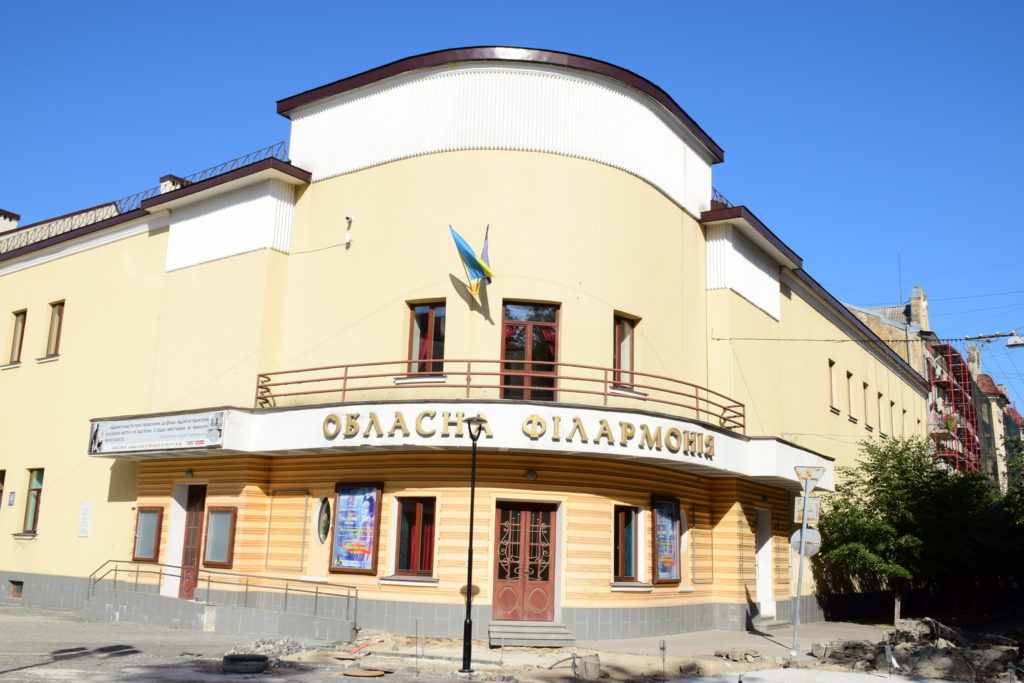
Ira Malaniuk Ivano-Frankivsk Regional Philarmonic. Temple of Art in Stanislavov (3 Les’ Kurbas St.)
Existing for several years, the Musical Society named after Moniuszko decided in 1887 to build a theatre. The gmina (commune) allocated a construction site, and the Savings Bank, for its part, provided material support for the project and after a four-year preparatory work, the construction of the theatre began on May 21, 1891. The cost estimate for building was 90,000 guilders. The local railway engineer Józef Łapicki, acting under the pseudonym Witold Miłkowski, was chosen as the executor. Everything was supervised by a specially formed construction committee. Construction was progressing at a fairly rapid pace and at the end of the year the building was erected. It could seat 800 spectators, had lodges, a balcony with seats and a gallery. On November 22, Józef Łapicki handed over the key to the temple of art – and at the same time to the citadel of the Polish word – to President Bolesław Szamejt. In the evening there was an inaugural concert conducted by a musical school director Michał Biernacki, in which guests from Lviv, including members of the singing association „Lute”, also took part.
Although the concert dedicated to the inauguration of the theatre came to an end, the construction activity was still ongoing. It lasted for the next few months until September 1892. However, this did not bother the fact that in the meantime the first Polish stationary theatre scene under the directorship of an experienced and recognized actor Lucjan Kwieciński managed to settle down here.
The building had other magnificent rooms in both aisles. Along the left aisle there was a place for a restaurant, and above it on the first floor was the musical school of the Moniuszko Society. Further in the middle, above the lobby, in the spacious room there was a balcony hall with access to the terrace.
Both the architecture of the theatre and its interior existed – with minor modifications – for the next several decades. Meeting the needs and current trends in art, it finally changed its appearance in the early 1930s.
Owners of the edifice of the Moniuszko Musical Society, however, had modest funds, which were insufficient even for providing cultural activities, let alone talk about the possibility of doing all the renovation work needed.
After long discussions and meetings, finally, in the summer of 1928, a thorough reconstruction of the building was started. On the technical side leads the city architect and engineer Stanisław Trela who was an extremely distinguished person in the city. Actually, owing to him, Stanislaviv achieved many modern buildings, the best proof of what is the town hall, which attracts much attention.
The investment works, lasting about a year, were limited to many essential changes, including: modern ventilation, central heating and electric wiring were installed. In addition, rooms in which there was a cashier, a buffet, a place for smoking, a wardrobe for the public, etc. were expanded. The auditorium was kept in a bright color, and the old chairs were replaced with new ones. Theatre named after Moniuszko in Stanislaviv – according to Ewa Nawrocka – was „the most beautiful and modern theatre in Poland at that time”.
More than three years later, the facade of the building was renovated, since it had made „a very sad and depressing impression”. Too huge costs did not allow the implementation of the fronton design according to Stanisław Trela, with six classic columns and a fancy entrance. The architecture was deprived of historical decorations, but it took on a simple cubic form instead. In September 1932, when the last work on the pediment was still ongoing, the press reported: „we are pleased to announce the fact that we finally have a theatre in Stanislaviv, which faces the dignity of the provincial (voivodeship) city.”
The appearance of the building has hardly changed since then. Except for one: once placed on the pediment, the inscription „Theatre named after Moniuszko” did not survive World War II and was removed. Nowadays, there is the Ivano-Frankivsk Regional Philharmonic named after I. Malaniuk in the building, and it is a venue for performances of Ukrainian and foreign artists.